
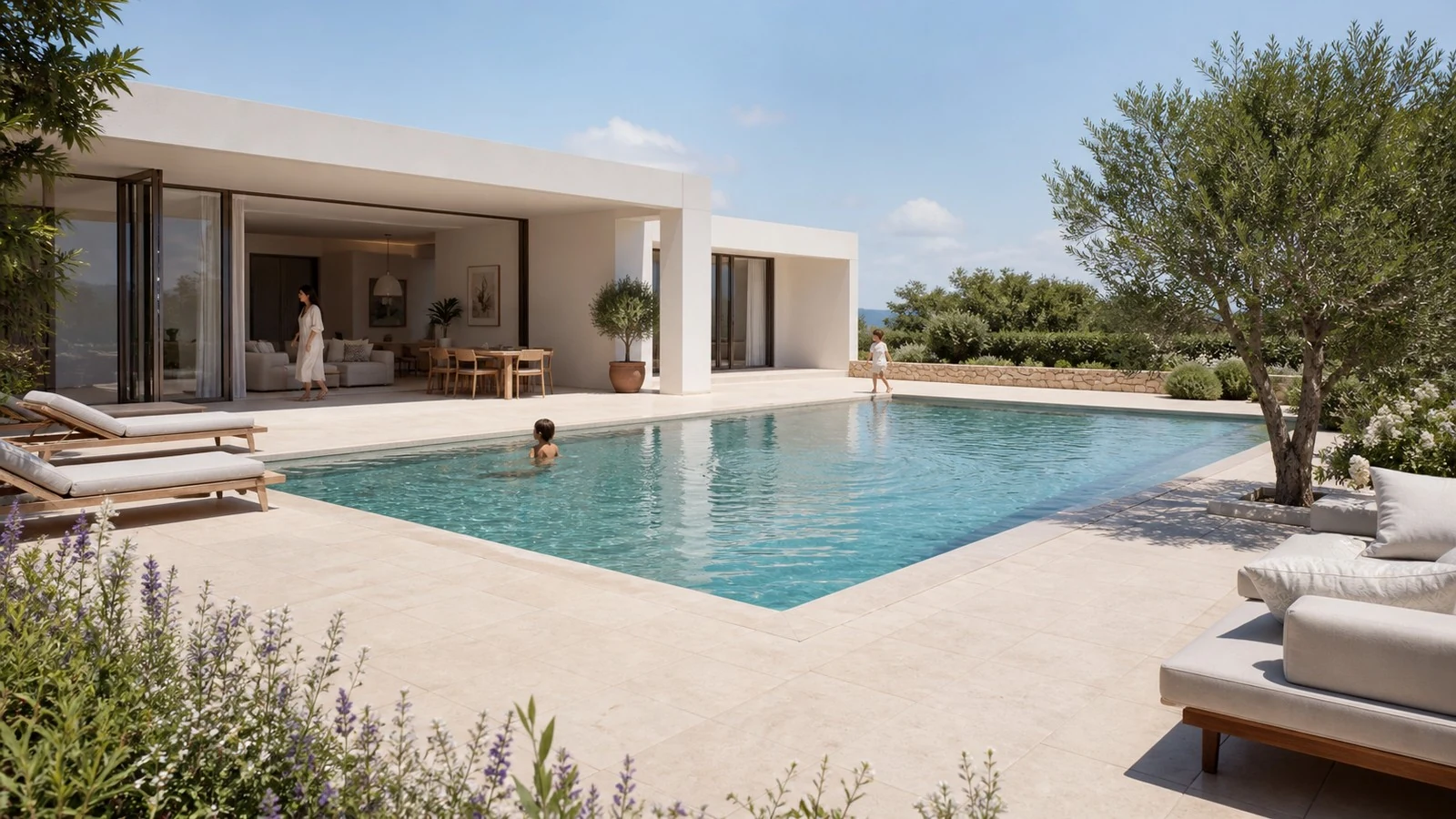
The narrow line around a pool unites water, deck and architecture as one composition. The MAZACURE standard for beautiful, usable pool architecture.
Coping is physically narrow but visually powerful. It establishes the apparent thickness of the pool edge, frames the water colour, carries material from the house into the landscape and affects how people sit or move beside the pool. AURA treats the edge as an architectural joint, not a finishing accessory.
1. Continue the architectural datum
When coping aligns with floor levels, wall bases and terrace lines, the pool feels embedded in the building composition. A quiet pale stone can make the transition nearly disappear, allowing water and architecture to read as related planes rather than separate installations.
DESIGN READING | A consistent limestone datum joins villa, terrace and complete pool.
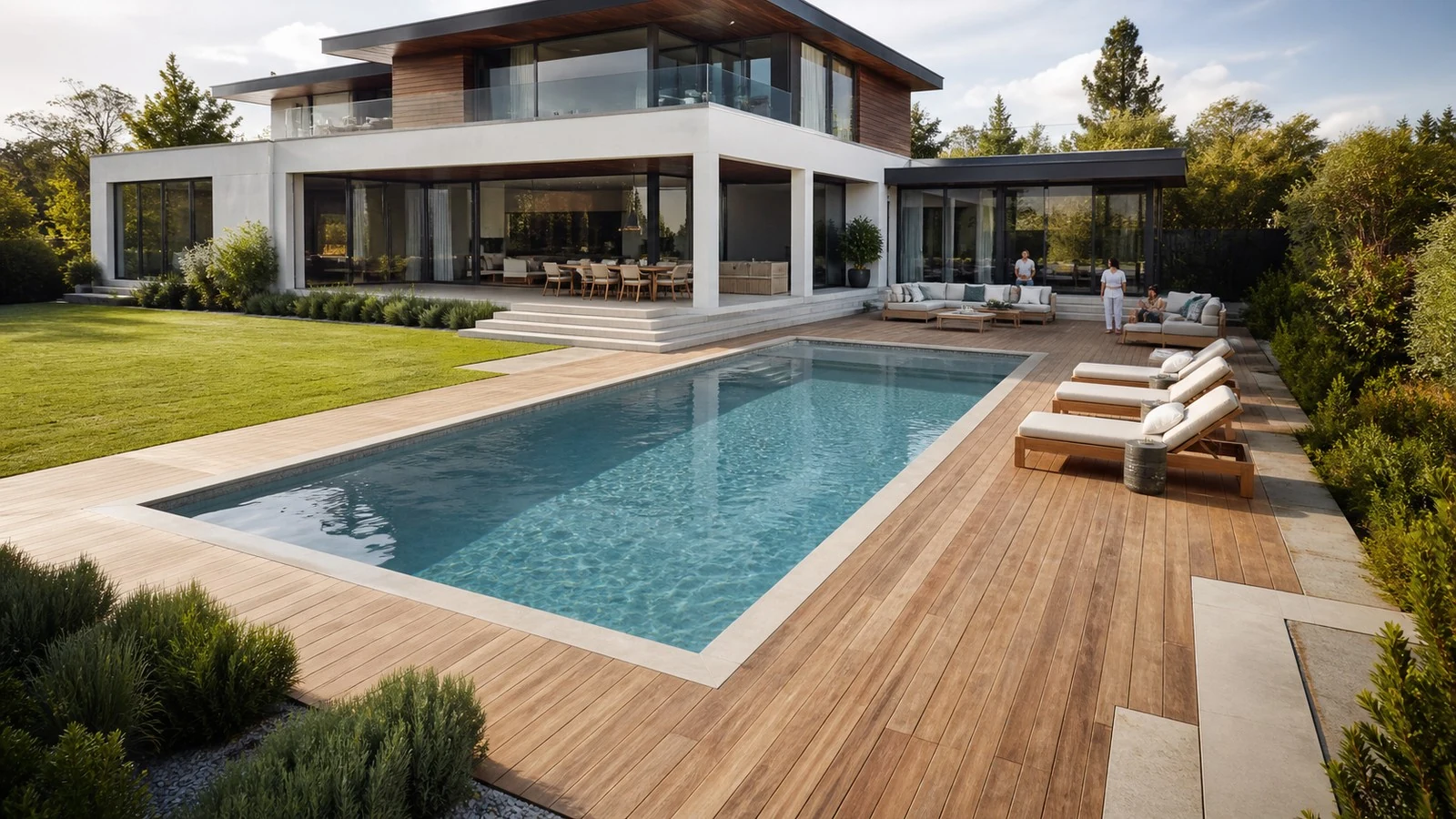
2. Use contrast to organise space
A narrow coping band can separate the water from a warmer timber deck and make both materials more legible. Contrast is most effective when it also explains use: durable circulation at the edge, softer lounging material beyond, and a clear frame around the water.
DESIGN READING | Material contrast clarifies circulation and leisure zones around the whole pool.

3. Coordinate joints with geometry
Large-format paving appears calm when its joints respond to pool corners, steps and building bays. Unplanned cuts create visual noise precisely where attention is strongest. Establishing a shared setting-out logic early makes the water, deck and facade feel intentionally composed.
DESIGN READING | Aligned paving joints extend the pool's geometric order into the courtyard.

4. Match the profile to behaviour
A softly rounded profile can support comfortable sitting and family use, while a crisp square edge can reinforce minimal architecture. The decision must respond to how people touch the edge as well as how it photographs. Elegance and comfort are not opposing goals.
DESIGN READING | A comfortable edge profile supports real use without weakening the design.

5. Frame the water colour
Coping colour changes the perceived boundary of the pool. A dark edge can sharpen pale water and connect to window frames or facade details; a light edge can soften the transition into stone paving. Always judge the choice across the complete scene, not from a material sample alone.
DESIGN READING | Dark coping frames the water and repeats architectural accents.

6. Create depth with shadow
A restrained reveal or floating-edge effect can add a precise shadow line and make coping appear lighter. At night, concealed light can emphasise selected sections, but the detail must remain subordinate to the pool itself. Consistency at corners and junctions is essential.
DESIGN READING | A controlled shadow reveal adds depth without turning the edge into decoration.
Design Check
- Set out coping and paving joints from one geometric reference.
- Choose profiles according to both architecture and touch.
- Review material samples beside actual water and facade colours.
- Resolve corners, level changes and terminations before installation.
Reference Notes
Belgard 2026 Catalogue - finishing touches and copinghttps://www.belgard.com/wp-content/uploads/2021/03/CPM-2026-Catalog_WEB_Single-Pages_BEL25-D-576600.pdf