

A family reunion reminds us that the best smart home is the one that makes more room for people. An original MAZACURE story of intelligent, human-centred design.
Arrivals
The first car arrived early. The second arrived while the gate was still closing. By sunset, shoes had multiplied near the entrance, cousins were calling across the courtyard and every adult had asked at least once who was watching the youngest child.
At the centre of it all stood Farid and Salma, grandparents and hosts, receiving each arrival as though the family had crossed an ocean rather than a city. The path lights brightened as evening settled. The gate opened for expected guests. The house moved from quiet afternoon to welcome without anyone abandoning a conversation to manage it.
A family reunion does not enter a home neatly. It rushes in carrying food, stories, forgotten chargers, new haircuts and old jokes. The space either resists the joyful disorder or expands around it.
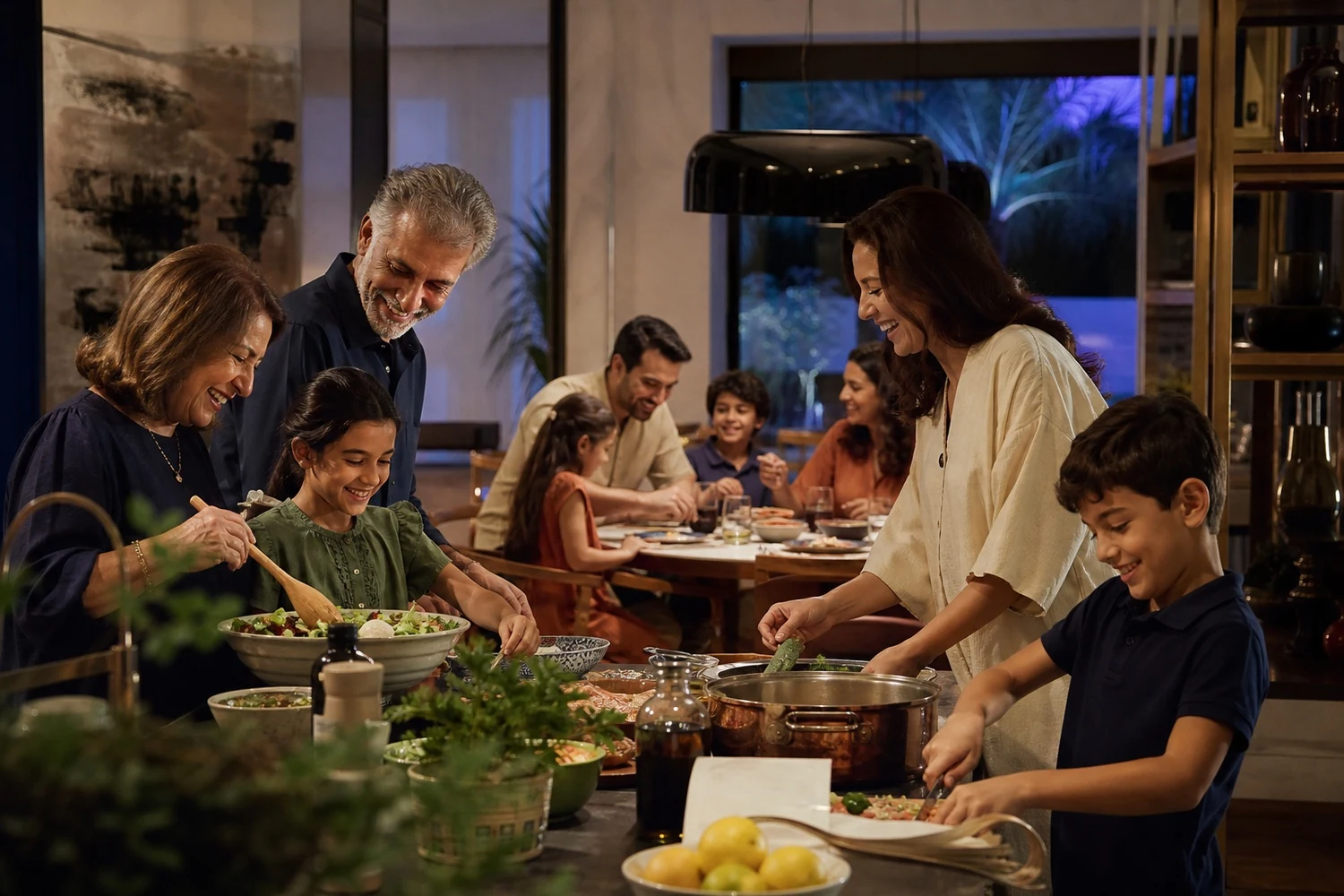
The kitchen becomes a country
By six, the kitchen had developed its own geography. One corner belonged to Salma's rice. Another had become a children's assembly line for herbs. Farid supervised a sauce nobody had asked him to supervise.
Lighting shifted brighter over the work surfaces while the dining area stayed warm. Music moved through the room at the volume of another relative - present, cheerful and perfectly tuned beneath conversation. Three generations cooked in overlapping rhythms.
Architectural photography favours empty rooms because they are easy to control. But a living home proves itself when it is full. Can people see what they are doing? Can the room change purpose without becoming complicated? Can the atmosphere support energy in one zone and conversation in another? Intelligence becomes meaningful when it can hold complexity gently.

Many evenings at once
After dinner, the reunion divided into smaller worlds. The grandparents listened to a story on the terrace. Teenagers claimed a corner of the living room. Younger children invented a game along the garden path while adults kept an easy eye on the illuminated pool.
From above, the property would have looked like one evening. From inside, it was a dozen evenings happening together: confidence by the water, laughter at the table, privacy in a quiet room, welcome still glowing at the gate for one late arrival.
AURA connects rooms, lighting, pool, access and routines because family life crosses all of them. One view can help the host understand the property, but the greater achievement is what everyone else does not have to understand. They simply move, gather and belong.

Before the photograph
Someone insisted on a family photograph. It took eleven minutes to bring everyone into the living room and another five to persuade the youngest child to face forward. The camera timer began. Farid made a comment nobody heard clearly, and the entire family broke into laughter one second before the picture.
It was not the perfect photograph. It was better. Salma later saved it as her favourite because no one was ready and everyone was themselves.
After the last car left, the house returned gradually to its evening calm. The path dimmed. The gate settled. The pool held the reflection of an empty terrace that no longer felt empty. The rooms carried evidence of everyone who had been there.
That is the promise behind AURA: not a home filled with technology, but a home with more room for life. Light. Water. Access. One calm experience. And, when the family arrives, one house ready to hold everyone.
Aura Reflection
The technology in this story is intentionally quiet. The experience is the product: a space that protects attention, supports connection and feels naturally ready for the people inside it.